In continuous automated production lines—whether conveying bulk ores, guiding delicate film webs, or squeezing textile fabrics through dye liquor—rollers are the direct mechanical interface between machine power and work-in-progress materials. Specifying the wrong roller leads to rapid surface degradation, web skewing, premature bearing seizure, or unexpected downtime.
This engineering guide provides a step-by-step checklist developed by the machine shop team at Mishree Engineers to help plant managers and mechanical designers select the right roller specifications.
1. Define the Primary Mechanical Function
Before evaluating materials, identify the exact role the roller serves in the machine kinematic chain:
- Idler / Guide Rollers: Support web tension with minimal rotational friction and low inertia. Ideal materials: Aluminium alloys (6063-T6) or lightweight thin-wall steel.
- Drive / Traction Rollers: Transmit torque to the web or conveyor belt without slip. Typically require grooved rubber (NBR/Neoprene) or polyurethane friction sleeves.
- Nip / Squeeze Rollers: Apply uniform pressure across the web width for dewatering, laminating, or coating. Require precision cylindrical or crown grinding to prevent edge pinch.
- High-Temperature / Release Rollers: Heat-sealing or hot-melt lamination where adhesives must not stick. Require PTFE (Teflon) coating or silicone coverings.
2. Calculating Deflection Limits & Core Sizing
When a roller spans widths beyond 1,000 mm, shaft and pipe deflection under uniform line load ($W$) or belt tension ($T$) becomes the governing failure mode. Excessive deflection causes web wrinkling at the center and bearing journal binding.
If deflection calculations indicate excessive sag, do not simply increase shaft diameter at the bearings; instead, specify a thicker-walled shell pipe or step up from mild steel to alloy steel (EN19/EN24) with internal reinforcement ribs.
3. Selecting Core Metallurgy
| Core Material | Key Properties | Best Applications |
|---|---|---|
| Mild Steel (IS 2062 / ST 52) | High rigidity, economical, easily welded | Bulk conveyor idlers, general drive drums |
| Stainless Steel (SS 304 / 316) | Superior corrosion resistance, acid/alkali proof | Textile wet processing, food processing, pharma |
| Aluminium (6063-T6 / 6082-T6) | Low rotational inertia (1/3 weight of steel), fast acceleration | High-speed film winders, slitter-rewinders, paper guides |
| Alloy Steel (EN8 / EN19 / EN24) | High yield strength, fatigue resistance, hardened journals | Heavy-duty pinch rolls, pipe bending rotators, drive shafts |
4. Choosing the Right Elastomer & Shore Hardness
When specifying a coated roller, elastomer selection dictates chemical resistance, thermal stability, and wear life:
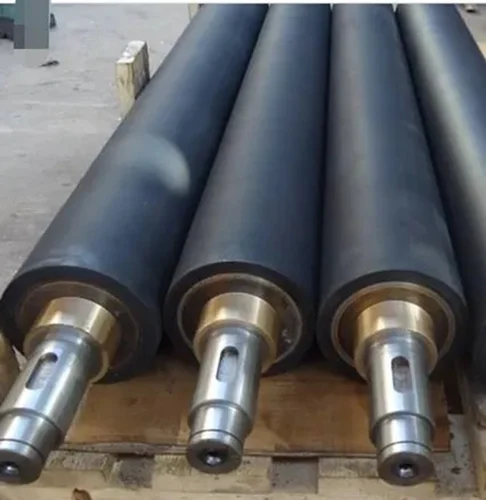
- Natural Rubber (35 – 90 Shore A): Exceptional resilience, high tensile strength, and good tear resistance. Economical choice for conveyor pulleys and general web guide rollers.
- Nitrile / NBR (45 – 95 Shore A): Excellent resistance to petroleum oils, greases, aliphatic hydrocarbons, and hydraulic fluids. Common in printing presses and solvent coating lines.
- EPDM (40 – 85 Shore A): Outstanding resistance to ozone, outdoor UV, ketones, alcohols, and steam up to 140°C. Preferred in plastic film Corona treatment and textile dyeing.
- Polyurethane (PU, 60 Shore A – 75 Shore D): Offers 3 to 5 times the abrasion resistance of standard rubber and handles heavy loads without flat-spotting. Ideal for metal slitting, packaging, and high-wear idlers.
- Silicone (30 – 80 Shore A): Operates continuously up to 220°C with superior non-stick release. Essential for plastic extrusion laminators and hot-melt adhesive coaters.
5. Balancing Requirements for High Line Speeds
A static balance check (rolling freely on knife edges) is only sufficient for slow-moving conveyor idlers below 150 RPM. Once line speeds exceed 150 m/min or rotational speeds exceed 300 RPM, centrifugal force generates dynamic couple unbalance.
Always request dual-plane dynamic balancing according to ISO 1940 Grade G2.5 for web converting, printing, and high-speed textile machines. Dynamic balancing extends bearing life by up to 300% and guarantees streak-free web travel.
Summary Checklist for Roller Procurement
- Outer diameter (OD) and face length (FL) with tolerances.
- Operating environment: maximum temperature, chemical exposure, washdown protocols.
- Line speed (m/min) and calculated rotational RPM.
- Shaft journal diameters, bearing sizes, and keyway specifications.
- Elastomer coating type, Shore A/D hardness, and required surface roughness (Ra).
- Dynamic balancing certification grade (ISO 1940 Grade G2.5 or G6.3).
Need Help Sizing Your Industrial Roller?
The application engineering team at Mishree Engineers reviews 2D/3D drawings, calculates load limits, and provides tailored material recommendations for plants across India.